Key takeaways
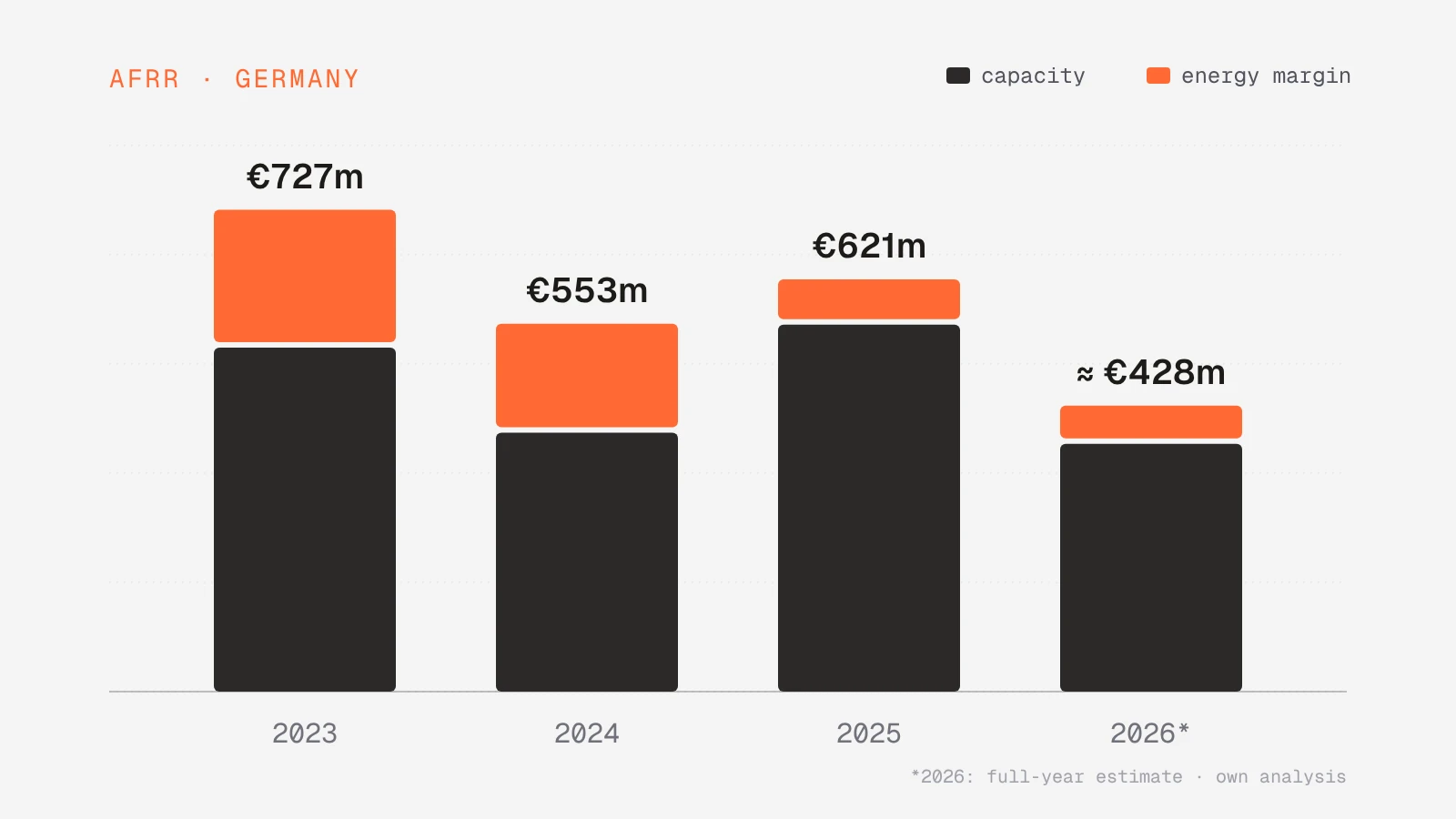
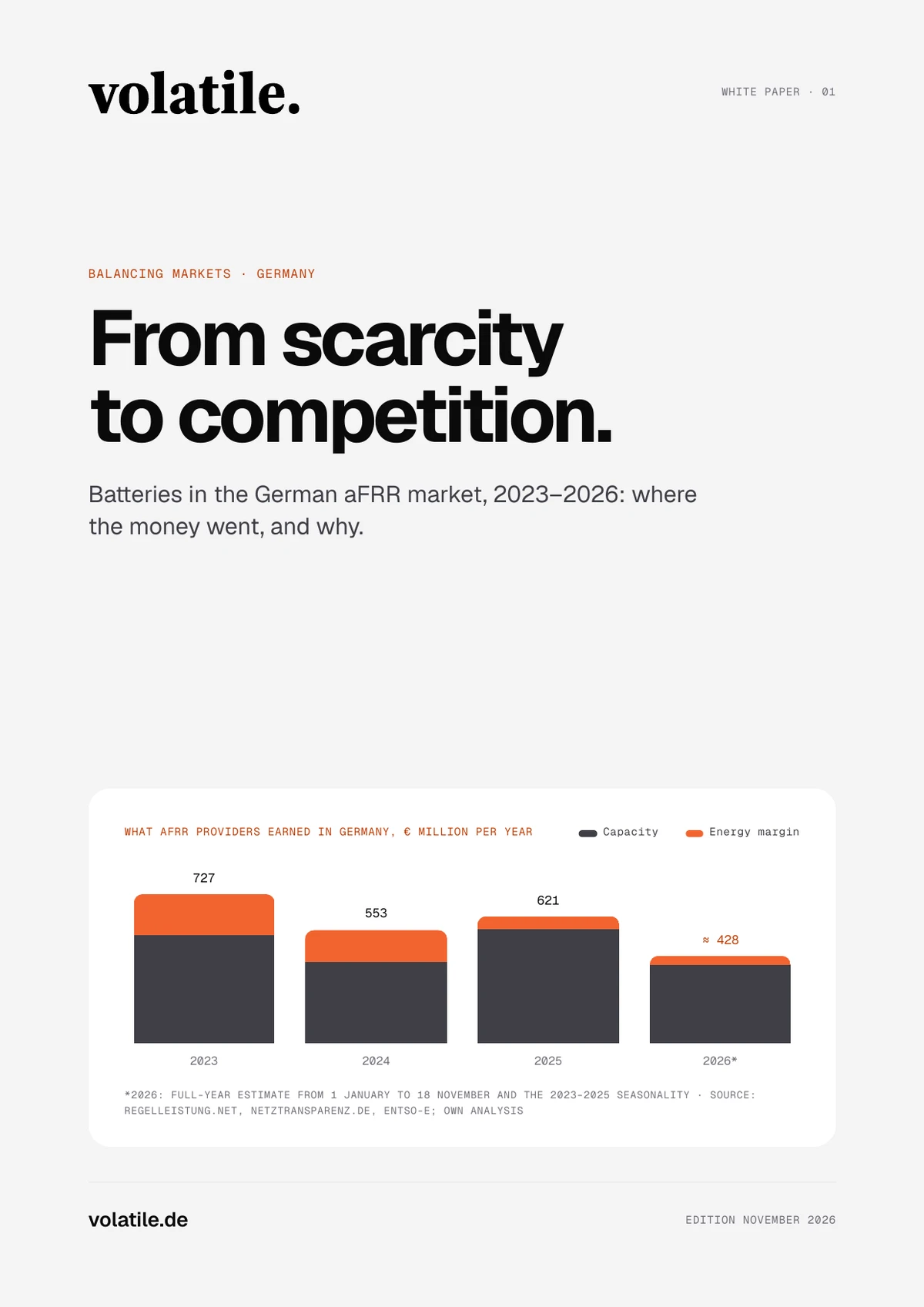
- German aFRR providers earned about €727m in 2023. For 2026 we estimate about €428m, 41 % less. The TSOs bought about the same amount of reserve throughout.
- The two halves fell at different times. In 2025 the energy margin collapsed while capacity payments rose. In 2026 positive capacity prices fell, although day-ahead trading paid more than ever.
- Behind it are more batteries and a larger European pool for aFRR energy. On its own, aFRR has lost most of its lead over FCR for a 2-hour battery.

How aFRR pays a battery
aFRR, automatic frequency restoration reserve, pays twice.
- Capacity: the day before delivery, the TSOs buy about 1.9–2.0 GW of positive and 1.8–1.9 GW of negative aFRR for each of six 4-hour products. Bids are paid as bid: an accepted bid earns its own price for every hour of the product, whether it is called or not.
- Energy: energy is bid separately from capacity. A capacity award obliges you to bid energy, but anyone prequalified can bid energy without one. Activated energy is paid at the European PICASSO price, which is set every 4 seconds.
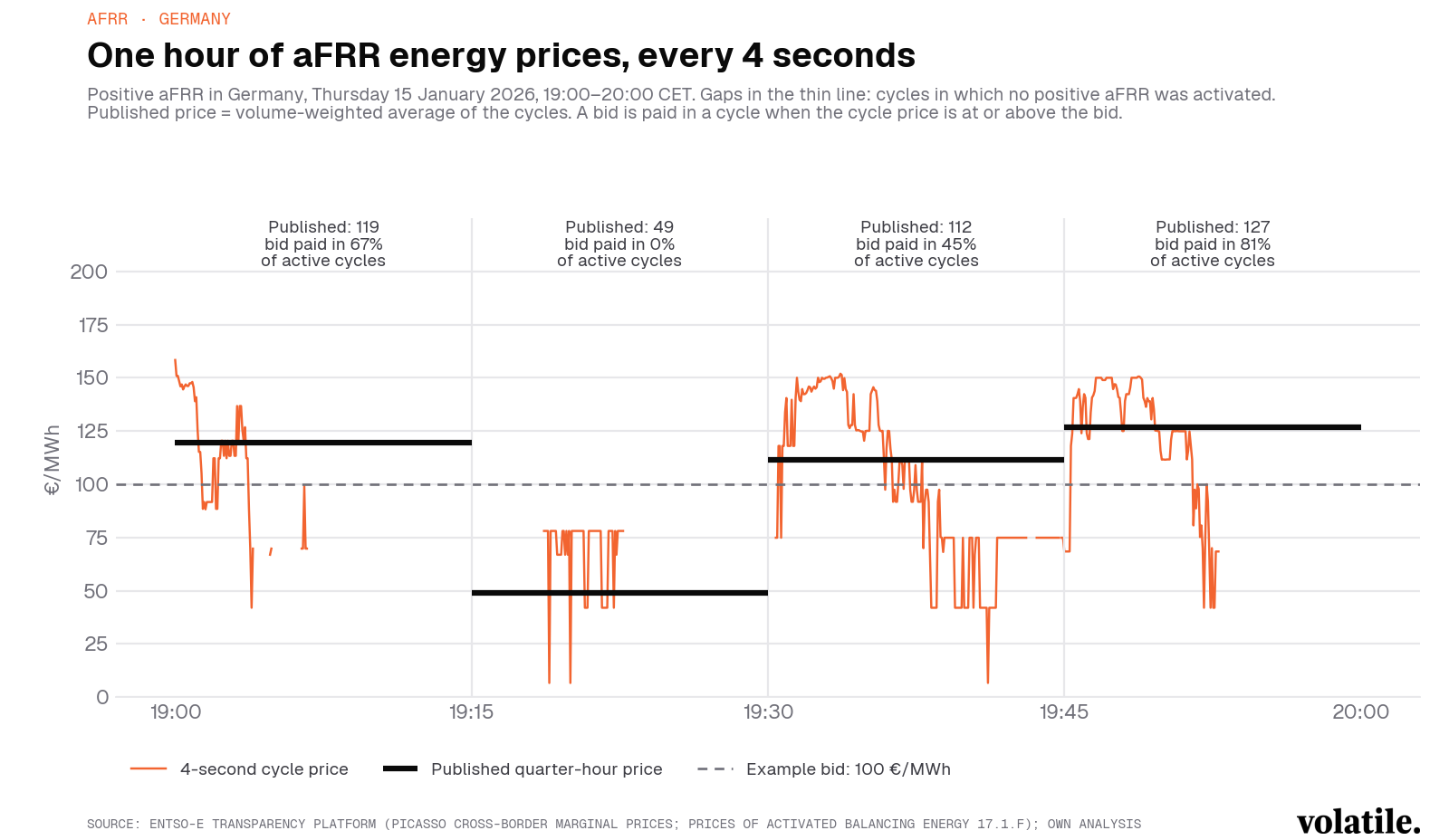
The 4-second price matters more than the quarter-hour average Germany publishes. Take 15 January 2026 and an energy bid at 100 €/MWh. From 19:30 to 19:45 the published price was 112 €/MWh, above the bid, yet the bid was paid in only 45 % of the cycles with positive activation. From 19:15 to 19:30 the published price was 49, and the bid was never called.
How you price the energy bid defines your strategy. In our simplified view there are three: capacity only (price the mandatory energy bid so high that it is rarely called; about one in six MW of positive energy offered sits more than 1,000 €/MWh above day-ahead, January–April of each year), capacity plus energy, and energy only (free bids, positive up from 205 MW on average in 2023 to 338 MW in 2026).
An accepted capacity bid is not free. Under the PQ-Bedingungen, the TSOs' prequalification conditions, a battery must hold at least 60 minutes of its marketed power for each direction it holds, plus a working range it sizes itself. It may refill that reserve by trading during the product.
Where the money went
We count two things: capacity payments to all contracted bids, and the energy margin (activation price over day-ahead) of all activated aFRR.
- 2023: €525m capacity + €202m energy margin = €727m
- 2024: €395m capacity + €158m energy margin = €553m
- 2025: €560m capacity + €61m energy margin = €621m
- 2026 (estimate): ≈€378m capacity + ≈€50m energy margin = ≈€428m
The 2026 figures are a full-year estimate: €396m to 18 November, scaled with the 2023–2025 seasonality (range €417–440m). Comparing only 1 January to 18 November of each year gives €669m → €396m, also −41 %. Our capacity totals for 2023 and 2024 are within 3 % of the costs the Bundesnetzagentur (BNetzA) publishes in its Monitoringbericht.
The money did not leave in a straight line:
- 2024: negative capacity payments fell from €283m to €171m.
- 2025: value shifted from energy to capacity. Capacity rose from €395m to €560m, energy fell from €158m to €61m, and the total grew from €553m to €621m. Part of the capacity gain came from pumped-storage outages from late August 2025.
- 2026: positive capacity payments fell from €309m to about €174m.
Capacity: more batteries, lower positive prices
Negative aFRR follows the sun. When the day-ahead price in a 4-hour product is below zero, negative capacity clears at about 71–76 €/MW/h (except in 2024); above 150 €/MWh at 3–6. Keeping charging room free costs a battery most exactly when power is cheapest. At low day-ahead prices that curve has barely moved since 2023. Negative capacity revenue fell from 2025 to 2026 because there were fewer such hours: 575 → 465 hours with negative day-ahead prices (January to October, 2025 → 2026).
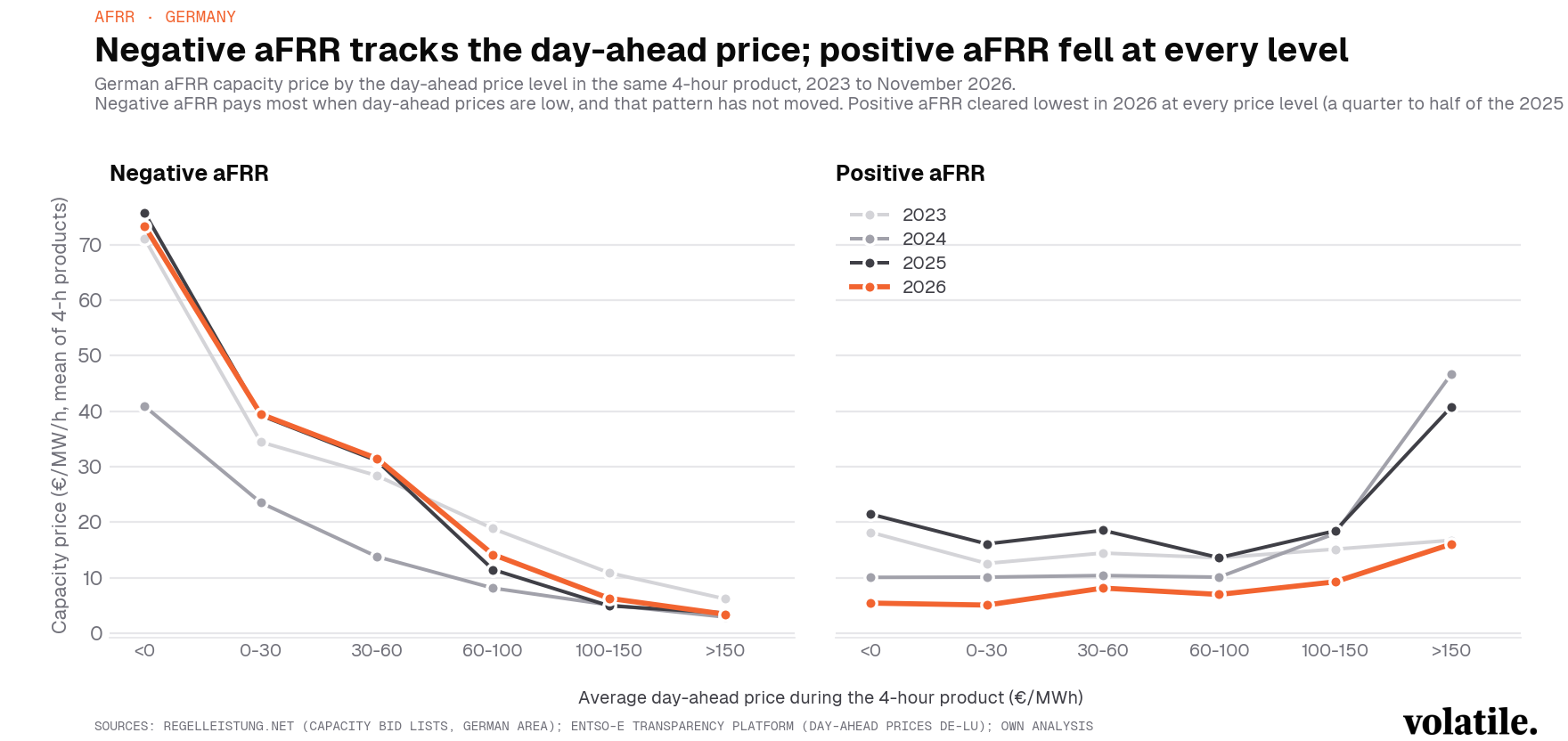
Positive aFRR got cheaper while day-ahead trading paid more. A battery holding positive capacity gives up part of its day-ahead trading, so wider day-ahead spreads should push capacity prices up. They did the opposite. From April to September, the average daily spread (best four hours minus worst four) widened from 87 to 160 €/MWh (2023 → 2026). The positive capacity price in the same months fell from 20 to 11 €/MW/h. In 2026 positive capacity cleared lower than in any earlier year at every day-ahead price level.
More gas generation does not explain it. Gas output rose from 5.0 to 6.0 GW on average (January–October, 2025 → 2026), but in 4-hour products with little gas running, positive capacity still fell from 17.8 to 6.2 €/MW/h.
Batteries outgrew the market.
- Large batteries (1 MW and above) in operation, according to the BNetzA Marktstammdatenregister (MaStR): 1.3 GW at the end of 2023 → 4.6 GW in November 2026. The fleet alone is more than twice the positive aFRR the TSOs buy, although only part of it is prequalified for aFRR.
- Battery capacity prequalified for positive aFRR: 0.06 GW (January 2023) → 1.2 GW (January 2026). Since 2025, batteries are the only technology whose prequalified volume still grows.
Prequalification is a licence, not an offer. Offered volume did not change much either: offers stayed at about twice demand for positive aFRR. Competition showed up in prices, not in volume.
Price spikes are supply events. Both capacity price spikes since 2023 came with pumped-storage outages. On 25 August 2025, German pumped-storage unavailability rose from 2.2 to 2.8 GW, and the positive capacity price from about 9 to 32 €/MW/h overnight.
Energy: first the spikes went, then the everyday margin
The aFRR energy margin over day-ahead fell from €202m in 2023 to about €50m in 2026, in two phases.
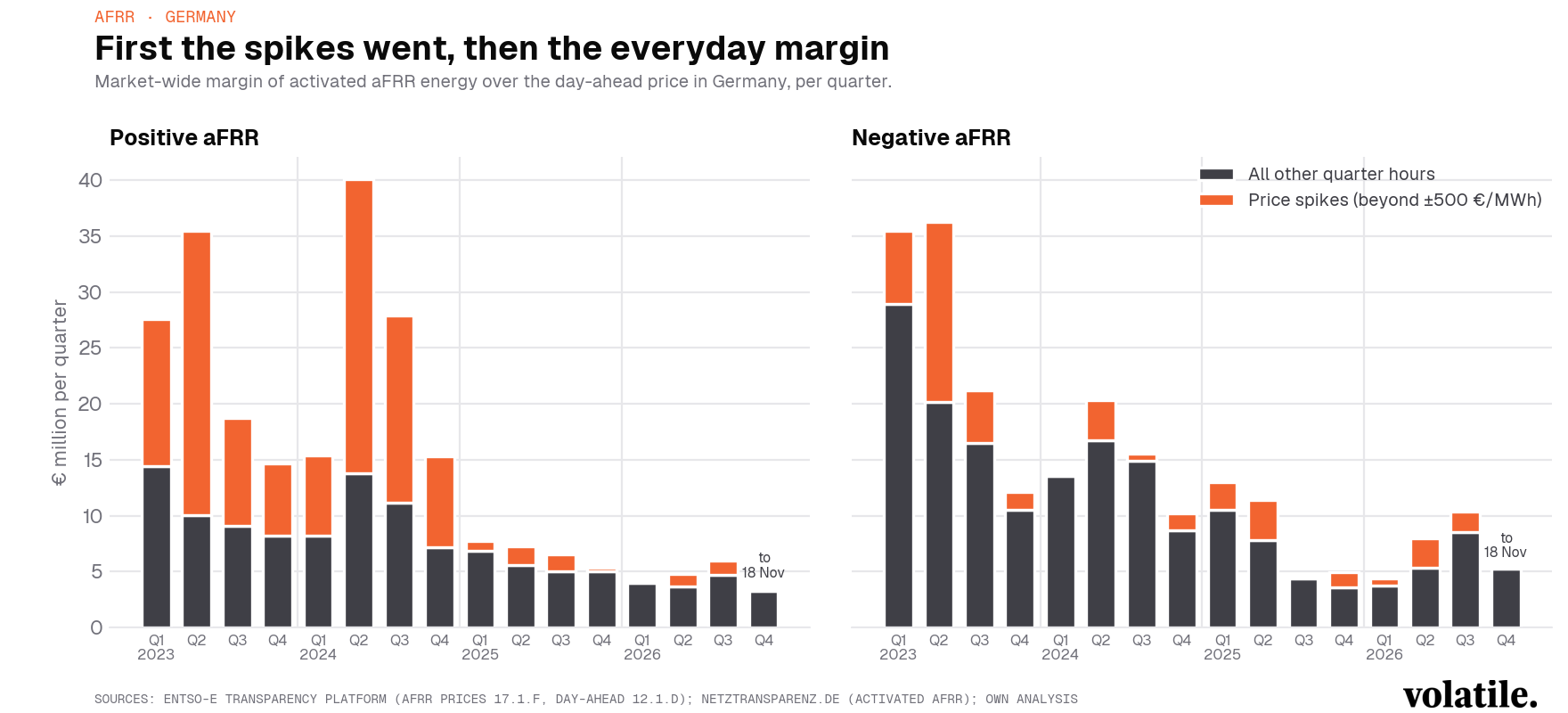
- First the spikes went. Quarter hours with aFRR energy prices beyond ±500 €/MWh earned €84m in 2023 and about €9m in 2026. Most of the drop came between August 2024 and April 2025, when PICASSO changed its price rule and eleven more TSOs joined.
- Then the everyday margin. All other quarter hours earned €118m in 2023 and about €41m in 2026. German energy bids moved towards the day-ahead price. In August to November 2026, the cheapest 100 MW of energy bids sat within about 1 €/MWh of a battery's loss break-even, against 41–43 €/MWh above it in the same months of 2023.
The break-even comes from round-trip losses: a battery buys back what it delivers at the day-ahead price, and with 10 % losses every activated MWh costs about one-ninth of the day-ahead price on top.
German prices became European prices. Since November 2024, Germany has shared its 4-second aFRR energy price with four to nine other areas on average, up from one or two before. A static test on our sample days shows the larger pool lowered German prices: the median gap between what German bids alone would have cost for Germany's need and the realised price grew from 3 to 39 €/MWh for positive aFRR (January 2023 – July 2024 → October 2024 – May 2026). Part of that step is PICASSO's new price rule, not only cheaper dispatch.
What it means for a battery
We valued each market on its own, per MW of battery, after 10 % round-trip losses: the battery earns only in aFRR, only in FCR or only in day-ahead trading. That is not how batteries operate, but it shows how each market changed. Per MW of a 2-hour battery and year:
- aFRR, capacity + energy: €192–308k in 2023 → €109–174k in 2026 (cautious to 80 % sizing)
- FCR (0.8 MW per MW of battery): €90k → €125k
- Day-ahead trading (two cycles a day, perfect foresight): €66k → €113k
Cautious sizing means 0.5 + 0.5 MW, keeping 2 hours of energy per direction, as in common battery revenue indices. 80 % sizing means at most 0.8 MW per direction with 15 % more energy than the 60-minute rule requires; this needs active charge management through intraday refill trades. FCR and aFRR assume award in every product at the average price, so all figures are upper bounds.
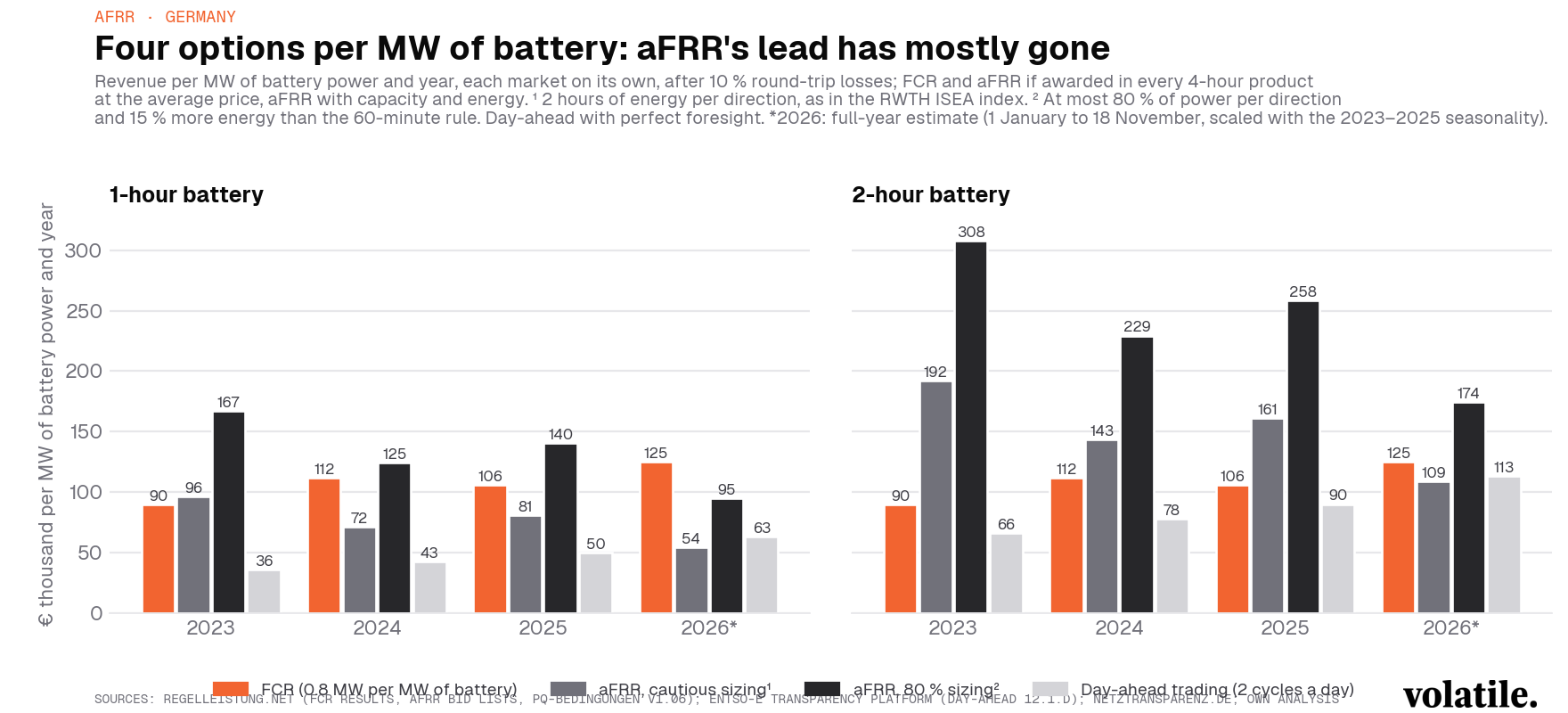
On its own, aFRR paid a 2-hour battery 2.1–3.4 times as much as FCR in 2023, and 0.9–1.4 times in 2026. A 1-hour battery now earns most in FCR, but the FCR market is only about 570 MW, an eighth of the large-battery fleet. Combined with trading, aFRR can still add value: holding part of the power in aFRR and trading the rest can earn more than any single market.
Our view
This section is opinion, not a forecast.
- More batteries are coming. The MaStR lists 12.9 GW of large batteries as planned, against 4.6 GW in operation. Not all of it will be built. Positive aFRR capacity will likely stay heavily contested and energy margins thin.
- Negative aFRR at midday looks more robust. Solar and negative prices set it, and that driver is not going away, although enough storage could erode it too.
- The weight shifts to trading. For most batteries, aFRR becomes one part of a portfolio decided day by day, valuable mainly in combination with trading.
What this means for you as an operator
- Decide daily, not once. The value sits in specific products: negative midday products in spring and summer, positive evening products, and in some years scarcity events such as pumped-storage outages.
- Price what you give up. A capacity bid needs a good view of day-ahead and intraday prices. Without one, you cannot price the alternative you sacrifice.
- Price your losses. Energy bids now clear near a battery's loss break-even. Recharge cost and efficiency decide whether an activation earns or costs money.
The full analysis, with methods, cross-checks and limitations, is in our whitepaper “From scarcity to competition: Batteries in the German aFRR market, 2023–2026”.
Method and sources
- Period: 1 January 2023 to 18 November 2026. 2026 yearly money figures are full-year estimates (year-to-date divided by the share earned by 18 November in 2023–2025); 2026 prices and rates cover 1 January to 18 November.
- Capacity: MW-weighted average accepted bid per 4-hour product, regelleistung.net anonymous capacity bid lists.
- Energy: activated aFRR (netztransparenz.de) × activation price (ENTSO-E Transparency Platform 17.1.F) minus day-ahead (SDAC DE-LU), per quarter hour, market-wide, before storage losses. On 15 days with per-second data, per-second settlement gave an 8–20 % higher margin, so our energy figures are conservative. A battery actually buys back in intraday: measured against ID1 instead of day-ahead, the margin is about 8–20 % lower in 2025–26.
- Why these two measures: capacity and energy both show what providers earn on top of the value of the energy itself. Capacity is a pure availability payment; its opportunity cost differs by provider and cannot be measured market-wide (the section “What it means for a battery” shows what it looks like for a battery). Energy is shown as a margin over day-ahead, because day-ahead is the market-wide reference value of energy.
- Batteries: BNetzA Marktstammdatenregister (MaStR) public unit search, storage units of 1 MW and above; prequalified capacity from the German TSOs.
Volatile platform
See our forecasts on your markets.
Tell us what you trade. We review every request and get back to you within 24 hours.